
How do you transfer gel to membrane
2025-09-26
MS
15
Protein gel transfer, commonly called "blotting," is a crucial step in techniques like Western blotting. It moves separated proteins from a gel onto a membrane for detection and analysis. Here’s a clear breakdown of the process:
1. Why do you need to transfer gel to membrane?
Gels aren't suitable for detection:Polyacrylamide gels used for protein separation are fragile and opaque.
Membranes are ideal surfaces:They bind proteins tightly and stably.
Enable targeted detection:Antibodies or specific probes need access to proteins.
Membranes are robust:They withstand repeated washing and incubation steps.
Provide a permanent record:Blots can be stored and re-probed.
Essential for identification:Transfer allows visualization of specific proteins using antibodies (Western blotting).
Facilitates quantification:Band intensity on the membrane correlates with protein amount.
2. How to choose the gel? How to choose the membrane?
Choosing the right gel and membrane is critical for successful transfer.
Choosing the Gel (SDS-PAGE):
Concentration (%T):Determines pore size. Match pore size to protein size.
Resolving Gel: Separates proteins based on molecular weight.
Stacking Gel:Concentrates proteins into a sharp band before separation.
|
Protein Size (kDa) |
Recommended Gel Concentration (%T) |
Purpose |
|
<10 |
15-20% |
Small proteins need small pores |
|
10-50 |
10-15% |
Standard range for many proteins |
|
50-100 |
8-12% |
Larger proteins need larger pores |
|
>100 |
4-8% (or gradient gels) |
Very large proteins require minimal resistance |
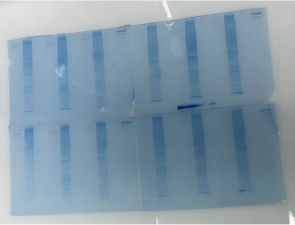
Photo of the gel
Choosing the Membrane:
Nitrocellulose (NC):
Pros: High protein binding capacity, inexpensive, compatible with most stains/detection methods.
Cons: Brittle when dry, lower mechanical strength, can tear easily.
Best for:General purpose Western blotting, routine applications.
Polyvinylidene Difluoride (PVDF):
Pros:High mechanical strength, can be stripped and re-probed multiple times, higher chemical resistance.
Cons:Requires pre-wetting in methanol, more expensive, can have higher background.
Best for:Applications requiring stripping/reprobing, sequencing, long-term storage, low molecular weight proteins.
|
Feature |
Nitrocellulose (NC) |
PVDF |
|
Binding Mechanism |
Hydrophobic |
Hydrophobic |
|
Binding Capacity |
High |
Very High |
|
Mechanical Strength |
Low (Brittle dry) |
High |
|
Methanol Pre-wet |
No |
Yes |
|
Stripping/Reprobing |
Poor |
Good |
|
Cost |
Lower |
Higher |
|
Best For |
Routine detection |
Reprobing, sequencing, low MW |
Photo of the membrane
3. How do you transfer gel to membrane?
Electrophoretic transfer uses electric current to drive proteins out of the gel onto the membrane. Three main methods exist:
(1)Prepare the Transfer Stack ("Sandwich"):
Cut filter papers, membrane, and gel to size. Wear gloves!
Pre-wet components: Soak sponges, filter papers, and membrane (PVDF must be soaked in 100% Methanol for 1 min, then equilibrated in transfer buffer) in cold transfer buffer.
Assemble on the cathode (-) core: Place on a tray filled with buffer.
Sponge
3 Filter papers
Gel
Membrane (ensure no bubbles between gel and membrane! Roll out with a tube or pipette)
3 Filter papers
Sponge
Roll out any air bubbles meticulously. Bubbles block transfer.
(2)Place Sandwich in Transfer Apparatus:
Insert the assembled sandwich into the transfer tank. Ensure the gel faces the cathode (-) and the membrane faces the anode (+). Proteins are negatively charged and move towards the positive electrode.
Fill the tank with cold transfer buffer (often containing Methanol for SDS removal and better protein binding, especially to NC). Use ice packs or a cooling unit if available. Heat reduces transfer efficiency and can damage proteins.
(3)Run the Transfer:
Connect the power supply.
Choose the Method & Settings:
Wet Transfer (Tank):Most versatile, best for high MW proteins or thick gels.
Voltage/Current: Constant 100V (~350-400 mA) for 60-90 min, or Constant 30-40V overnight (14-16 hrs).
Buffer: Contains 10-20% Methanol.
Semi-Dry Transfer: Faster, uses less buffer, good for routine MW ranges.
Current: Constant 0.8 - 2.5 mA per cm² of gel area. Time: 15-60 mins.
Buffer: Usually lower ionic strength, may contain Methanol or SDS.
Dry Transfer (Systems like iBlot):Fastest (5-10 mins), no liquid buffer, proprietary.
Follow manufacturer's protocols precisely.
|
Transfer Method |
Time |
Buffer Consumption |
Cooling Needed |
Best For |
|
Wet (Tank) |
1-16 hrs |
High |
Yes |
High MW, thick gels, best efficiency |
|
Semi-Dry |
15-60 min |
Low |
Sometimes |
Routine MW range, speed |
|
Dry (e.g., iBlot) |
5-10 min |
None (Proprietary) |
No |
Extreme speed |
(4)Post-Transfer Steps:
Turn off power:Disassemble the sandwich carefully.
Confirm Transfer:Visually check for pre-stained markers on the membrane. Stain the membrane briefly with Ponceau S (reversible) or the gel with Coomassie Blue (permanent) to visualize transferred proteins or remaining proteins.
Block the Membrane: Incubate the membrane in a blocking solution (5% non-fat dry milk or BSA in TBST) for 1 hour at room temperature. This prevents non-specific antibody binding.
Proceed to Detection:The membrane is now ready for incubation with primary and secondary antibodies and your chosen detection method (e.g., chemiluminescence, fluorescence).
Key Success Factors:
Eliminate Air Bubbles:Crucial for even transfer.
Correct Orientation: Gel (-), Membrane (+).
Cold Temperature: Prevents overheating and protein damage.
Appropriate Buffer & Method: Match to protein size and membrane.
Optimal Transfer Time/Current:Avoids under-transfer (proteins left in gel) or over-transfer (proteins pass through membrane).
By understanding the "why", carefully selecting your gel and membrane, and meticulously following the transfer steps, you ensure proteins move efficiently for successful downstream detection and analysis.